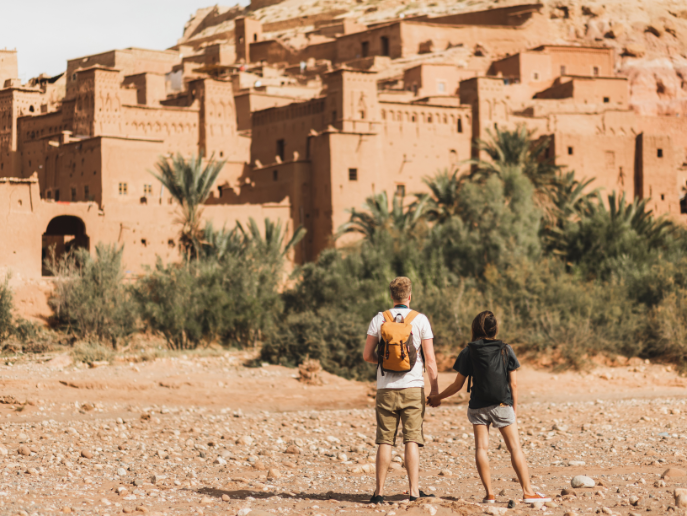
Telouet Kasbah is the former stronghold of the Glaoui family, once the most powerful clan in southern Morocco, and it remains one of the country's most striking yet least visited historic sites — a partially ruined palace with rooms of ornate zellige tilework, carved cedar ceilings and painted plaster still intact despite decades of abandonment. It sits just off the Tizi n'Tichka pass road, roughly 30 minutes from Ait Ben Haddou, making it an easy and worthwhile add-on rather than a trip of its own.
The Glaoui family effectively ruled the Atlas region and much of southern Morocco during the French protectorate era in the early-to-mid 20th century, amassing enormous wealth and political power as pashas of Marrakech. Telouet was their ancestral seat, built and expanded over generations into a sprawling complex of reception rooms designed to impress visiting dignitaries. When the family fell from favor after Moroccan independence in 1956, the kasbah was abandoned and has been slowly decaying ever since, which is precisely what makes visiting it feel so different from more restored sites.
Unlike a polished museum, Telouet is largely unrestored, which gives it an atmospheric, slightly haunting quality — you're walking through genuine decay rather than a reconstruction.
Ait Ben Haddou, a UNESCO World Heritage kasbah, is far more visited, restored, and set up for tourism, with cafes and guided routes through its ramparts. Telouet sees a fraction of the visitors, has no real infrastructure beyond a small entrance fee and an informal caretaker, and rewards travelers looking for something quieter and less polished. Most itineraries that cross the Tizi n'Tichka pass, such as an Ait Ben Haddou UNESCO private day trip, can add Telouet as a stop along the same road with only a modest detour. Our dedicated Ait Ben Haddou day trip guide covers that better-known site in full.
Wear sturdy shoes, since floors are uneven stone and some areas have exposed drops where the roof has collapsed. There's a small entrance fee paid on-site, and a local caretaker often shows visitors around informally — a tip is appreciated. The site has no cafe or facilities, so plan to eat before or after in Telouet village or continue on to Ait Ben Haddou. UNESCO's overview of Morocco's protected heritage sites, including the wider Ait Ben Haddou listing, is available on the official UNESCO World Heritage list for Morocco.
Bring a flashlight or use your phone's light for the darker interior rooms, allow 30-45 minutes to explore at a relaxed pace, and combine it with Ait Ben Haddou on the same day rather than treating it as a separate outing, since both sit along the same Tizi n'Tichka route from Marrakech.
Kasbah Ait Ben Haddou UNESCO Private Day Trip
Tell us what you have in mind and we'll build a private itinerary around it.
Get a Free Quote


